THE GLITCH
It was always the cat.
The Matrix isn’t a horror movie. Nobody hides behind the couch when Keanu Reeves dodges a bullet. But one scene has quietly haunted cat people since 1999. Neo walks up a staircase, a black cat strolls past a doorway… and then the exact same black cat strolls past the exact same doorway again. Trinity freezes. Déjà vu, she explains, is a glitch in the Matrix. It happens when they change something.
In a movie about machines and a simulated world built to keep everyone asleep, the thing that gave the whole game away was a cat. Not a hacker. Not a prophecy. A cat, walking where it wants, refusing to follow the script, and making everyone stop and ask, wait… what was that?
That’s why this is our Halloween issue. Cats see things we don’t. They stare at empty corners. They knock the comfortable lie off the table and watch it shatter. So here’s the most inspirational thing we can hand you this October 31st: be the glitch. Being yourself when the world keeps handing you a script is a small act of rebellion. Asking questions when everyone else is nodding along is how you notice the cat walking by twice. And finding the truth, even the gory kind, is where purpose lives. Nobody ever found their reason for being by staying asleep.
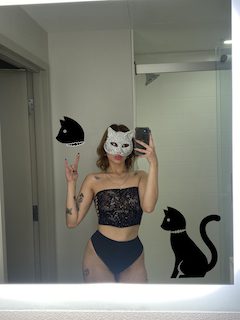
Our cover star is exactly the kind of glitch the system can’t patch. BB Purr is 22, from Los Angeles, and in every frame of this issue she plays the final girl, the masked stranger and the plot twist all at once. We dressed her shoot up like a midnight triple feature: our top three gore movies, the real crimes behind one of them, and a certain clawed dream-stalker put on trial.
P.S. Missed the black cat on the cover? Scroll up. It walks by twice. Click it.
 ⤢ tap to enlarge

 ⤢ tap to enlarge
Saw (the first three, before it got out of hand)
Before there were ten of them, before the traps needed an engineering degree, there was one grimy bathroom, two men chained to pipes, a hacksaw and a tape recorder. The original Saw (2004) was made by two young Australians, director James Wan and writer Leigh Whannell, for about $1.2 million, and it pulled in roughly $104 million worldwide.
What made the first three special wasn’t just the blood. It was the question: Jigsaw never kills anyone directly. He puts people in a room and asks how badly they want to live. Saw II (2005) went bigger with a whole house of strangers, and Saw III (2006) closed the original story with the most brutal choices in the series. After that, a sequel showed up almost every Halloween, and the twists started needing twists of their own.
Cat lover’s note: Saw’s whole message is “appreciate your life.” Cats already know. Nine of them, and they still nap like every one counts.
swipe →




Same chair. Something changed.
Drag across the photo. The clear chair didn’t move… but the glitch did.

 SCENE 17 · THE CLEAR TRAPSCENE 18 · GAME OVER
The Strangers
A couple (Liv Tyler and Scott Speedman) come back to a remote vacation house after a wedding reception that went sideways. It’s 4 a.m. There’s a knock at the door. A young woman on the porch asks for someone who doesn’t live there. Then three masked strangers spend the rest of the night taking that house apart.
The gore here is less buckets-of-blood and more dread you feel in your teeth. The masks never come off. And when the couple finally asks why are you doing this?, the answer is the coldest line in modern horror: because you were home. No motive. No backstory. That’s what makes it stick.
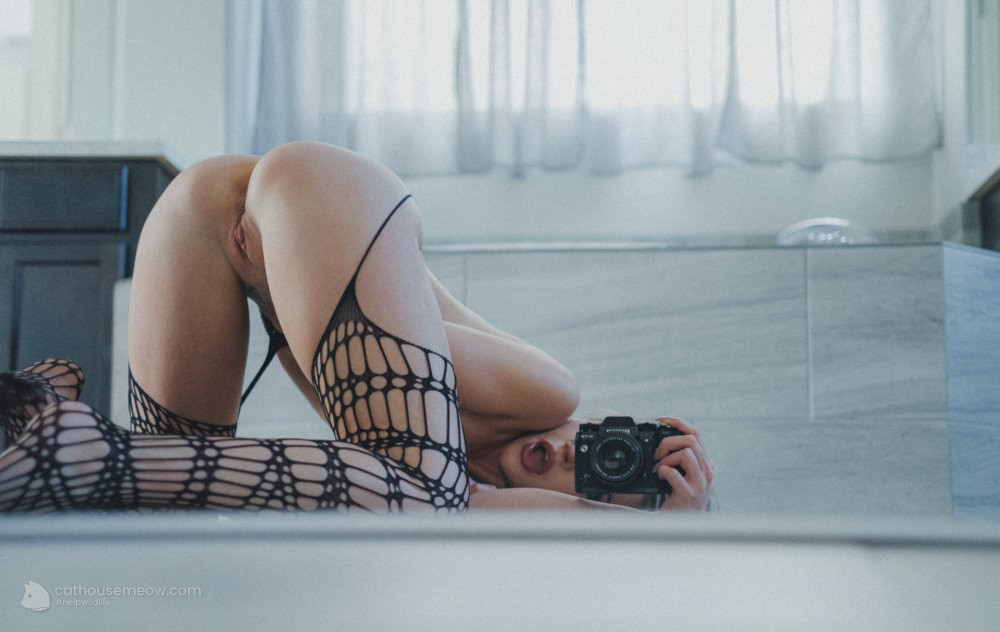
Behind them: BB turns the camera on us. Photographer and subject in one frame. In this house, the stranger is you.
“Based on true events”?
The poster says so. The real answer is weirder and scarier than a simple yes.
🗂 Open the case file
1. The knock. When Bertino was a kid, someone knocked on his family’s door late at night asking for a person who didn’t live there. He later learned people had been going door to door checking which houses were empty and breaking in. That memory became the film’s opening.
2. The Manson Family murders. Bertino has talked about reading Helter Skelter as a kid. In August 1969, followers of Charles Manson walked into homes in Los Angeles and killed people they didn’t know, including actress Sharon Tate. That random, “because you were there” cruelty is the spine of the movie.
3. The Keddie cabin murders. In April 1981, in the resort town of Keddie, California, a mother, her son and his friend were killed inside Cabin 28; her 12-year-old daughter vanished that night, and her remains were found years later. It’s still unsolved. Bertino has never confirmed it as a source, but fans keep pointing out the parallels: an isolated cabin, multiple attackers, no clear motive.
Cat lover’s note: A cat would never have opened that door. A cat would have stared at it from across the room for forty-five minutes and then left. Be more cat.
 ⤢ tap to enlarge

The Texas Chain Saw Massacre
Number one had to be the house with the bone furniture. A van full of young people runs out of gas in rural Texas, wanders up to the wrong farmhouse, and meets Leatherface: a hulking man in a mask made of other people’s faces, carrying a chainsaw like it’s part of his arm. Then comes the dinner scene. If you’ve seen it, you just shivered.
The wild part: Tobe Hooper’s 1974 original shows surprisingly little blood. It just feels like the goriest film ever made, because the grimy film, the screaming and that roaring saw make your brain fill in the rest. The 2003 remake, directed by Marcus Nispel and starring Jessica Biel, filled in everything your brain left blank. That’s the one gore fans reach for.
It was sold as a true story, and it’s only partly true. Leatherface was loosely inspired by Ed Gein, a Wisconsin man arrested in 1957 whose farmhouse held things nobody should describe at a dinner table.
You might have heard this one called “Rob Zombie’s Texas Chain Saw Massacre.” We checked. Rob Zombie never directed a Chain Saw movie. What he made is House of 1000 Corpses (2003) and The Devil’s Rejects (2005): a cannibal farmhouse family, travelers who take the wrong turn, and enough Chain Saw worship to count as a love letter. See? Asking questions works.
Cat lover’s note: Leatherface wears other people’s faces because he doesn’t know who he is. That’s the real horror. Wear your own face, kitten. It’s the only one that fits.
Same kitchen. Same red suit. Look closer.
Drag the cat across the frame to see what changed.

 SCENE 12 · THE RED SUITSCENE 13 · THE CAMERA BLINKED FIRST
 ⤢ tap to enlarge
What’s yours?
Pick your favorite, or type in the one we’re criminally forgetting.
The cancellation of Freddy Krueger
For a whole generation, Freddy was the fun one. The striped sweater, the fedora, the glove with knives for fingers, the one-liners. Robert Englund played him like a vaudeville act from hell, and in 1984 Wes Craven turned him into one of the most original monsters ever filmed: a killer who gets you in your dreams, the one place you can’t run from.
But the story always had something rotten underneath. In Craven’s original, Freddy preyed on the children of Elm Street, and when the courts let him go on a technicality, the parents burned him alive. The first film kept the worst of his crimes in the shadows. Kids in the ’80s grew up with Freddy dolls and posters without really knowing what he was.
Then came the 2010 remake. Directed by Samuel Bayer, produced by Michael Bay’s Platinum Dunes, and written by Wesley Strick and Eric Heisserer (story by Strick), it said out loud what the original only hinted at. Jackie Earle Haley’s Freddy was a preschool groundskeeper who abused the children in his care, and the plot revolves around those kids growing up and remembering. No more winking. Freddy was confirmed, on screen, as a child predator.
That’s what quietly cancelled him. The remake made money (more than $117 million on a $35 million budget) but almost nobody loved it, and nobody knew what to do with Freddy afterward. Today’s audiences don’t want to laugh along with a predator, and they’re right. The franchise has been asleep for fifteen years.
Can he be saved?
There’s one honest way to do it. Don’t make Freddy lovable again, and don’t make his crimes the spectacle. Make the movie about the survivors. Nancy was always the real hero of Elm Street: a girl nobody believed, who stayed awake, asked questions, dragged the monster into the light and refused to give him her fear. Freddy as pure nightmare, never the punchline; the kids as the ones who finally wake everyone up. Sound familiar? It’s the glitch again.

YOU ARE THE GLITCH
The Matrix isn’t a horror movie. But cats are scary, because they see the truth and don’t apologize for it. Your Halloween homework from all of us at the Cat House: be yourself even when there’s a script. Ask the question even when the room goes quiet. Look for the truth even when it’s gory. That’s where purpose lives.
And if you ever see a black cat walk past the same doorway twice? Don’t look away. Something just changed. Maybe it was you.
Starring BB Purr · Shot for Cat House Meow · Every view helps support the wild ones through The Cat House Foundation · Happy Halloween 🐈⬛