Eat Clean, Spend Less,
Grow Your Own
Organic produce now runs 59% above conventional at the American checkout — up from 52.6% a year ago. Here’s what the actual weekly ads say, where the retailers really differ, and how a few ceramic pots close the gap yourself.
The receipt doesn’t lie. A new LendingTree analysis of USDA price data, out this month, puts the organic premium at 59% over conventional produce — a jump from 52.6% just a year prior.1 Some categories moved even faster than the average: organic Roma tomato prices nearly tripled over the past year, and organic green bell pepper prices more than doubled.1 Meanwhile the average American household spent just under $8,000 on groceries in 2024, before this year’s climb.1 The premium is real. So is the workaround.
This piece covers three things: what the actual grocery-store price data says about where to spend an organic budget, how to grow your own fruit in ceramic pots to sidestep the premium entirely, and why the plastic pot itself might be working against you.
Part One — What the Weekly Ads Actually Show
Forget the annual average for a second — the retailer-to-retailer spread is where the real money moves. A 2026 Consumer Reports basket comparison, run by Strategic Resource Group across six metro areas, used Walmart as its baseline and found Aldi running about 8.3% cheaper, while Kroger’s basket — even counting sale prices and loyalty-card discounts — came in 14.8% higher.2 Run that math forward and a $100 Walmart basket is roughly a $114.80 basket at Kroger.2
Category-level catalogue data tells a similar story. A Q1 2026 price audit across Walmart, Kroger, and Target found cooking oil carrying the widest spread of the categories tracked — a 14.4% difference between the cheapest and most expensive listing — followed by cereal at 11.4% and frozen pizza at 10.1%.4 Milk and eggs, the staples people check most often, showed the smallest gaps, at 8.9% and 9.1% respectively.4
| Item | Walmart | Kroger | Target | Spread |
|---|---|---|---|---|
| Milk (1 gal) | $3.48 | $3.79 | $3.69 | 8.9% |
| Eggs (dozen) | $2.98 | $3.25 | $3.19 | 9.1% |
| Breakfast cereal | $4.12 | $4.59 | $4.49 | 11.4% |
| Frozen pizza | $5.44 | $5.99 | $5.89 | 10.1% |
| Cooking oil | $7.82 | $8.95 | $8.67 | 14.4% |
Q1 2026 category averages, sampled across store locations.4
On organics specifically, real-time catalogue data moves week to week in both directions — Kroger’s own weekly ad for September 9–15, 2026 showed organic spinach ticking up roughly $0.20 while organic strawberries dropped about $0.25 the same week.5 That volatility is exactly why LendingTree’s annual 59% figure is a floor, not a fixed number — the actual gap on any given week depends on what’s moving through a specific store’s supply chain.
What the USDA’s Own Forecast Adds
The USDA’s February 2026 outlook, built off Consumer Price Index tracking, flagged eleven grocery categories rising faster than their 20-year historical average, including beef and veal (up 15% year-over-year as of January 2026, with a further 5.5% rise forecast for 2026), nonalcoholic beverages (+5.2%), and sugar and sweets (+6.7%).6 One rare bit of relief: egg prices, after last year’s spike, are forecast to fall 27.4% in 2026.6
Four Ways to Actually Use This Data
- Shop Aldi for the staples, wherever it’s within reach. The 8.3%–plus average gap versus Walmart, and the wider one versus Kroger, compounds fast on a weekly basket.
- Use Kroger’s loyalty program deliberately or skip it. Kroger’s sticker price runs meaningfully higher than Walmart’s — the loyalty and fuel-point stack is what closes that gap, not the shelf price.
- Buy organic where the year-over-year jump is smallest, not just where the item is available. Categories moving 100%+ year-over-year, like Roma tomatoes, are the ones to substitute or grow yourself first.
- Watch the weekly ad, not the annual average. A single week’s Kroger flyer already showed a given organic item moving 5–8% in either direction — that’s where near-term savings actually live.
Part Two — Grow Your Own in Ceramic Pots
The most durable hedge against a rising organic premium isn’t a better coupon — it’s not needing to buy the item at all. Berries, citrus, and compact tomato varieties all do well in ceramic or terracotta containers on a patio, balcony, or windowsill.
| Fruit | Min. Pot | Notes |
|---|---|---|
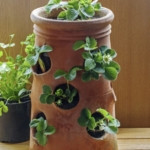
| Strawberries | 10–12″ deep | Classic terracotta strawberry jars with side pockets. Mix early, mid, and late varieties for a spring-to-fall harvest. |
| Blueberries | 18–24″ wide | Need acidic soil — easier to control in a pot than in ground. Plant two compatible varieties to boost pollination. |
| Citrus | 14–20″ diameter | Unglazed terracotta’s breathability suits citrus roots. Bring indoors before frost; needs 6+ hours of direct sun. |
| Blackberries & raspberries | 5+ gal tub | Trailing varieties do well in large glazed ceramic, which holds moisture better for these water-loving canes. |
| Tomatoes (small variety) | 12–14″ deep | Cherry and patio tomatoes thrive in pots — among the steepest year-over-year organic price movers, making them a priority to grow. |
Given that organic Roma tomatoes nearly tripled in price over the past year alone,1 a $30–$50 terracotta pot and a $5–6 pack of starts pays for itself fast — and keeps paying off across every season after that.
Part Three — The Pot Can Undermine the Harvest
What most home growers never check: the plastic container their fruit is growing in may be shedding into the soil. The University of Maryland Extension puts it plainly — cracked, degraded plastic containers release microplastics and possibly toxins and should not be planted with edible crops.7
A Plastic-Free Growing Checklist
- Choose ceramic or unglazed terracotta. These don’t degrade the way weathered plastic pots do, and they last for years.
- Check for plastic-free starter pots. Manure-based and peat-based seed-starting options are now standard at most garden centers.
- Skip plastic mulch film and landscape fabric. Both break down into microplastic fragments over a growing season.
- Use natural ties. Twine or cloth strips instead of plastic zip-ties.
- Favor wood or metal tools. They outlast plastic-handled versions and don’t shed into the soil.
The Honest Math
A ceramic strawberry pot, a bag of quality potting soil, and a handful of starts run well under what a single season of organic strawberries costs at 59% above conventional.1 The pot is a one-time purchase. Pair it with shopping the categories where the year-over-year jump is smallest — and steering staples toward whichever chain’s actual weekly ad, not its reputation, is cheapest that week — and the gap between wanting to eat clean and affording it gets a lot smaller.
Every dollar redirected from the organic markup toward smarter shopping and home-grown produce is a dollar households can put elsewhere — including toward the causes the Foundation supports in sanctuary care and community feeding programs. Read more on the Foundation’s page.
Endnotes
- LendingTree analysis of USDA price data, “Organic Produce Costs 59% More Than Conventional, Study Finds,” September 2026 — wbng.com
- Consumer Reports / Strategic Resource Group basket comparison, via NewsBreak, “Walmart, Aldi or Kroger: Where Does a $100 Grocery Budget Stretch Furthest?” September 2026 — newsbreak.com
- Independent 109-item basket price comparison, “America’s Cheapest Grocery Store in 2026,” September 2026 — joyfullythriving.com
- Q1 2026 category price audit, “Walmart vs Kroger vs Target Grocery Price Comparison 2026” — retailscrape.com
- Kroger Weekly Ad, September 9–15, 2026 — weeklyadboard.com
- USDA Economic Research Service, February 25, 2026 CPI food-price outlook, via Parade/AOL, “USDA Predicts Grocery Prices to Rise in 2026 for Beef, Pork, and More” — aol.com
- University of Maryland Extension, “Growing Vegetables in Containers and Salad Tables,” 2026 — extension.umd.edu
- “Can microplastics threaten plant productivity and fruit quality?” Science of the Total Environment, ScienceDirect, 2023 — sciencedirect.com
- Jessica Damiano, Associated Press, “Plastic Garden Gear Can Add Microplastics to the Soil. Here Are Some Alternatives,” April 2026 — oskaloosa.com