The Redwood in the Parking Lot
One of the planet’s most glamorous trees is moonlighting as office landscaping. Was it trucked in like a diva on tour, or has it simply been holding court longer than the building?
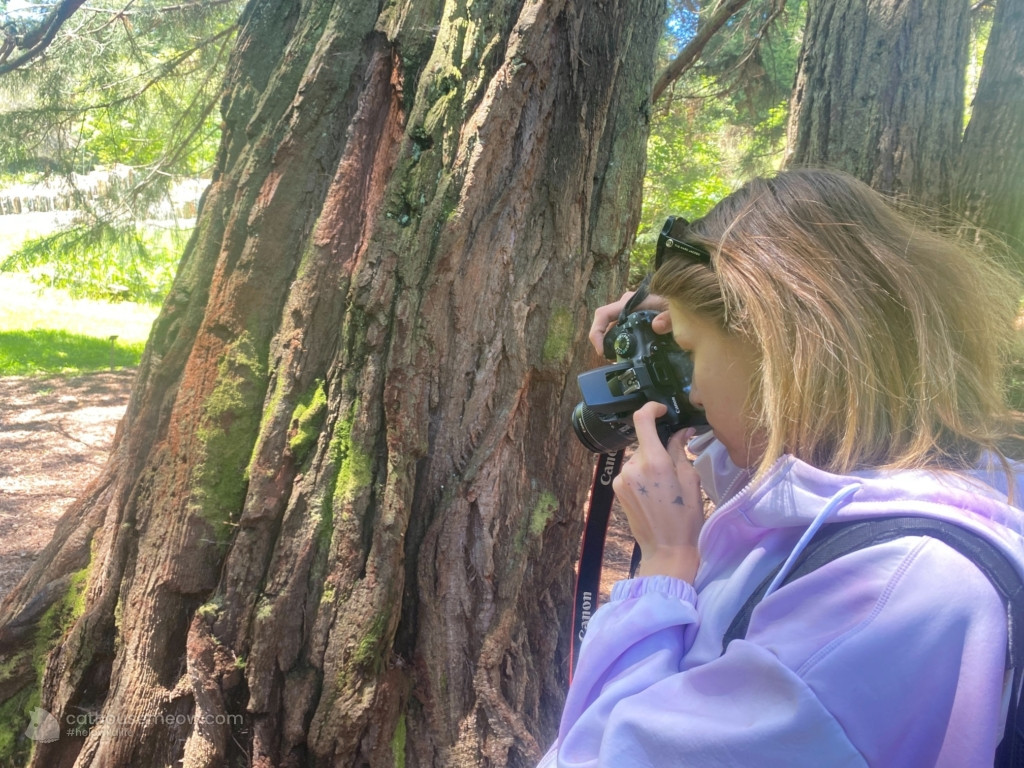
Picture it. A rainy Thursday, a business park built to be forgotten, a parking lot in tidy gray, and then, rising out of a strip of lawn like a red-carpet arrival nobody invited, a redwood. Its trunk is wider than a café table. Its bark is cinnamon on top and storm-dark below. Its roots spill over the curb like a cat that refuses to stay in its bed. Our editorial desk was asked the obvious question: did the streets grow up around the tree, or did somebody hire a crane and bring the tree to the streets? Let’s get to the root of it.
Planted small, grew up on the job
Sorry, conspiracy fans. A tree like this almost certainly arrived as a modest nursery sapling when the lot was landscaped, then did what redwoods do best: grew fast and never stopped. That flared, buttressed base with roots running across the soil is the signature of a tree that has anchored itself in one spot for decades. Trees delivered in a box don’t look like that.
Then there’s the engineering, and it is where the transplant theory runs out of road. One of Australia’s larger tree movers, Established Tree Transplanters, runs a fleet of hydraulic tree spades. Its biggest machine maxes out at trees about 15 metres (roughly 49 feet) tall, with a trunk about 400 millimetres (roughly 16 inches) across and a weight of up to six tonnes.12 Our parking-lot giant is easily twice that width. Anything bigger means hand-digging and a crane. Western Australia’s conservation department once documented a single tree weighing 37 tonnes, dug out by hand and craned into the sky.13 It can be done. It’s just not how anyone decorates a visitor-parking island.
Coast or dawn? A redwood identity parade
“Redwood” is a family name shared by three species, and two of them love a corporate address. Here’s how to tell the cousins apart:
Coast Redwood
Dawn Redwood
- Winter look
- Drops every needle, goes bare
- Hometown
- Hubei Province, central China
- Leaves
- Grow in strictly opposite pairs17
- Party trick
- Declared extinct, then found alive
The easiest test costs nothing: come back in January. Bare branches mean dawn redwood. Still green means coast redwood. Either way, you’re looking at royalty.
The tree that ghosted the fossil record
If it’s a dawn redwood, settle in, because it has the best comeback story in botany. In 1941 the Japanese botanist Shigeru Miki named Metasequoia from fossils and assumed the tree was long gone. Two years later, Chinese foresters collected specimens from a mysterious living tree in a Hubei village then called Modaoxi. In 1948, researchers confirmed it: Metasequoia, very much alive.17 The forester who first collected it, Wang Zhan, stumbled on the tree in 1943 while travelling to survey the forests of Shennongjia. He told the whole story on audio tape in 1986, and it was finally published as a posthumous paper in 2025.16
Then the seeds went global. A seedling and seeds reached Japan in 1949 as a gift to the imperial household, and by 1953 about 400 of them had been planted in a single forest.17 Every dawn redwood in a parking lot today is a descendant of that wartime discovery. Not bad for a tree that was supposed to be extinct.
Born in a greenhouse, raised on a bench
No, nobody is digging up wild forests to decorate office parks. Landscape redwoods come from nurseries, and coast redwoods are often cloned rather than grown from seed. The reason is a little embarrassing for such a grand tree: it makes loads of seed, but very little of it sprouts. Spain’s Lourizán Forest Research Centre, run by the Galician regional government, keeps a living gene bank of coast redwoods and clones them from cuttings.10 Its published method reads like a spa menu for twigs:
The redwood cutting, a treatment in six courses
- The hard prune. Parent stumps are cut back hard so they push out fresh, vigorous shoots.
- The bed. Trays of 80 percent peat and 20 percent perlite, plus fungicide and rooting hormone: indole-3-butyric acid (IBA), at 4 grams per litre of water.
- The selection. Only upright leading shoots are taken, so the young tree grows tall and straight.
- The soak. A 10-minute fungicide bath, a lengthwise nick at the base, then a 2-minute hormone dip.
- The settling in. Cuttings are tucked into the trays and watered.
- The steam room. High humidity for the first months and heated trays underneath, until roots form and the plants graduate to pots.
In one Lourizán trial, 64 percent of 125 cuttings rooted and became proper little trees.10 From there, a commercial redwood climbs the container ladder: pot, bigger pot, wooden box. Then a developer places an order, a flatbed rolls up, and a small crew tucks it into a curbed island with a sprinkler line. Ta-da: your parking-lot giant’s origin story.
Proof that planted redwoods get huge, fast
If a nursery twig turning into a skyscraper sounds far-fetched, look abroad.
In Rotorua, New Zealand, the government planted coast redwoods at Whakarewarewa Forest in 1901.1 The planting crews came from prison camps, and by 1926, when the trees were just 22 years old, they had left the European larch planted beside them looking skinny and frankly embarrassed.3 Scion, New Zealand’s Crown forestry research institute, says the species keeps growing hard for centuries and has no major insect or disease problems.4 The country’s redwood plantings had spread to roughly 10,000 hectares by 2018.5
Spain has its own glamorous accident. Around 1940, foresters in Cantabria planted coast redwoods on Monte Cabezón, hoping to grow home-grown industrial timber.6 By the time the trees matured, nobody needed the wood, so all 848 of them, on about 2.5 hectares, were left standing and in 2003 crowned a protected natural monument.7 Two of the world’s most admired redwood forests outside America began exactly like the tree in the business park: as humble planted saplings.
The quiet stresses of parking-lot life
- Too much love. Monte Cabezón’s town hall has begged visitors to stop hugging its redwoods, because people were stripping bark and trampling the soil until roots lay exposed.8 A parking strip does the same thing every day, with tyres.
- Nowhere to stretch. Curbed islands give roots nowhere to go, so they surface.
- Sprinkler tan lines. A dark, mossy lower trunk on a landscape redwood is often years of irrigation spray rather than disease. Only a certified arborist can say for sure.
And when a big tree truly has to move
For the rare occasions a mature tree must relocate, South Australia’s Department for Infrastructure and Transport publishes a government rulebook for the job.11 Think of it as the redwood’s private moving service:
The big-tree move, step by step
- Mark the north side of the trunk so the tree faces the same way in its new home. Redwoods have a good side too.
- Root-prune at least six months ahead. A trench is cut around the future root ball, refilled with sandy loam and kept moist with roughly 100 litres of water every third day.
- Dig the root ball by hand or machine, trimming exposed roots flush with sharp tools so the soil stays intact.
- Lift with slings around the trunk’s balance point and under the root ball. A tree is never hoisted by its trunk alone.
- Wrap the root ball in untreated natural burlap for the ride.
- Replant in a hole 600 to 1,000 millimetres wider than the ball, but never deeper.
- Brace it with at least three guy wires anchored at 45 degrees.
- Pamper it: 100 to 120 millimetres of mulch, kept off the trunk, and drip irrigation across the whole root plate.
How to find your tree’s real birthday
You don’t need a chainsaw to date a redwood. Scroll back through historical aerial photos in online map tools and watch the canopy appear. Ask the property manager for the original landscape plans. Check the local planning department’s site permits. You may discover your “ancient” giant is younger than the lobby carpet, and still taller than everything in sight.
A small ambassador for an endangered dynasty
The coast redwood is listed as Endangered by the International Union for Conservation of Nature (IUCN), largely because historic logging shrank its old forests.14 Only about 5 percent of the original old-growth coast redwood forest remains intact.15 A redwood in a business park will never replace an old-growth grove. But it is a working ambassador for one, and it deserves better than compacted soil and a careless weed whacker. Give it mulch, give it room, and please stop parking on its toes.
A Note from The Cat House Foundation
Every great forest starts as somebody’s small decision to plant. The Cat House is a conscious for-profit company, and a share of what our readers and members support goes toward animals and humanity, from feeding programs and beach cleanup supplies to awareness campaigns for at-risk wildlife. This season, in the spirit of our “Go Outside. Mark Your Territory.” campaign, find the biggest tree in your neighbourhood, pick up the litter around its roots, and leave it a little better than you found it.
#PleasureWithPurpose #CatHouseMeow #WhiskersApproved #LuxuryUnleashed #RedwoodRoots #GoOutside
Endnotes
- Te Ara – The Encyclopedia of New Zealand, Manatū Taonga Ministry for Culture and Heritage. “Whakarewarewa Forest Park.” teara.govt.nz/node/16470
- New Zealand Tree Register. “Redwood Memorial Grove, Whakarewarewa (BPR/G0936).” register.notabletrees.org.nz/tree/view/936
- Edwards, Vivien. “If Trees Could Talk: the Whakarewarewa Redwoods.” Paekōroki, Tauranga City Libraries. paekoroki.tauranga.govt.nz/nodes/view/20049
- Scion (New Zealand Forest Research Institute). “Redwood could help NZ reach 2050 net-zero emissions target,” 1 June 2022. scionresearch.com
- Scion. “Coast Redwood” information sheet. scionresearch.com (PDF)
- Del Cerro Crespo, A., Cebrecos Brogeras, M. & Ríos Bartolomé, C. “Monumento natural de las Sequoias del Monte Cabezón.” Foresta, Colegio Oficial de Ingenieros Técnicos Forestales. forestales.net (PDF)
- Escapada Rural. “¿Por qué hay un bosque de secuoyas en Cantabria?” escapadarural.com
- Xataka. “Cansado de los turistas, un pueblo de Cantabria les ha pedido algo inusual: que dejen de abrazar a sus secuoyas.” xataka.com
- Ayuntamiento de Málaga, Jardín Botánico Histórico La Concepción. “La planta del mes de diciembre es la sequoya,” 2023. malaga.eu (PDF)
- Centro de Investigación Forestal de Lourizán, Xunta de Galicia. “Conservación e propagación vexetativa do banco de xermoplasma de Sequoia sempervirens de Lourizán,” 2024. lourizan.xunta.gal (PDF)
- Government of South Australia, Department for Infrastructure and Transport. “Specification Part L19: Tree Transplanting and Relocating,” December 2017. dit.sa.gov.au (PDF)
- Established Tree Transplanters (Australia). Tree spade capabilities. establishedtrees.com.au
- Department of Biodiversity, Conservation and Attractions, Western Australia. Landscope magazine, tree relocation feature (photos: Botanic Gardens and Parks Authority). library.dbca.wa.gov.au (PDF)
- Conifers Garden encyclopedia. “Sequoia sempervirens,” citing Farjon, A. & Schmid, R., IUCN Red List of Threatened Species, 2013. conifersgarden.com
- IUCN Red List assessment of the redwood lichen Calicium sequoiae (Reese Næsborg, 2021), via redlist.info. redlist.info
- Wang Zhan (posthumous). Account of the discovery of Metasequoia glyptostroboides. Biodiversity Science (Chinese Academy of Sciences), 2025, 33(1): 25045. biodiversity-science.net
- Japan Ministry of Land, Infrastructure, Transport and Tourism, Japan Tourism Agency multilingual database. “22nd Century Asian Forest” (Metasequoia). mlit.go.jp